Owning a pool in Englewood Cliffs, New Jersey, comes with a particular set of rewards and responsibilities. The homes here sit on some of Bergen County’s most coveted properties, and the pools that accompany them tend to be equally impressive: custom designs, integrated spas, and sophisticated automation systems that require genuine expertise to maintain. Finding reliable pool service in Englewood Cliffs, NJ, isn’t just about keeping water blue. It’s about protecting a significant investment, preserving your property’s value, and making sure every weekend from mid-April through October feels effortless. Whether you’ve owned your pool for a decade or just finished construction, the quality of care you choose shapes your entire experience. The right service provider handles everything from chemistry to equipment health, so you can simply enjoy the water. This guide covers what premium pool care actually looks like in this part of Bergen County and what to expect from a provider that treats your property the way it deserves.
Table of Contents
Premium Residential Pool Solutions in Englewood Cliffs
Englewood Cliffs pools aren’t cookie-cutter installations. Many feature vanishing edges, attached spas, water features, and high-end finishes that demand specialized attention. A premium service provider recognizes these differences and adjusts their approach accordingly, rather than applying the same routine to every backyard.
The best providers assign a dedicated technician to your home. That single point of contact learns your pool’s quirks, your filtration schedule, your preferred temperature, and even how your landscaping affects debris patterns. Wayves operates on this model: the same technician visits every week, knows your equipment inside and out, and treats your property with the kind of familiarity that only comes from consistency. Your technician texts before arriving and sends a post-visit summary with before-and-after photos and a full chemical report, so you’re never left guessing what happened while you were at work.
Weekly Maintenance and Chemical Balancing
A proper weekly service visit involves far more than skimming leaves and tossing in chlorine tablets. Water chemistry is a system of interrelated variables, and adjusting one affects the others. Free chlorine should sit between 2.0 and 4.0 ppm, pH between 7.4 and 7.6, and alkalinity between 80 and 120 ppm. Calcium hardness matters too, especially for plaster and pebble finishes where levels below 200 ppm can slowly dissolve the surface.
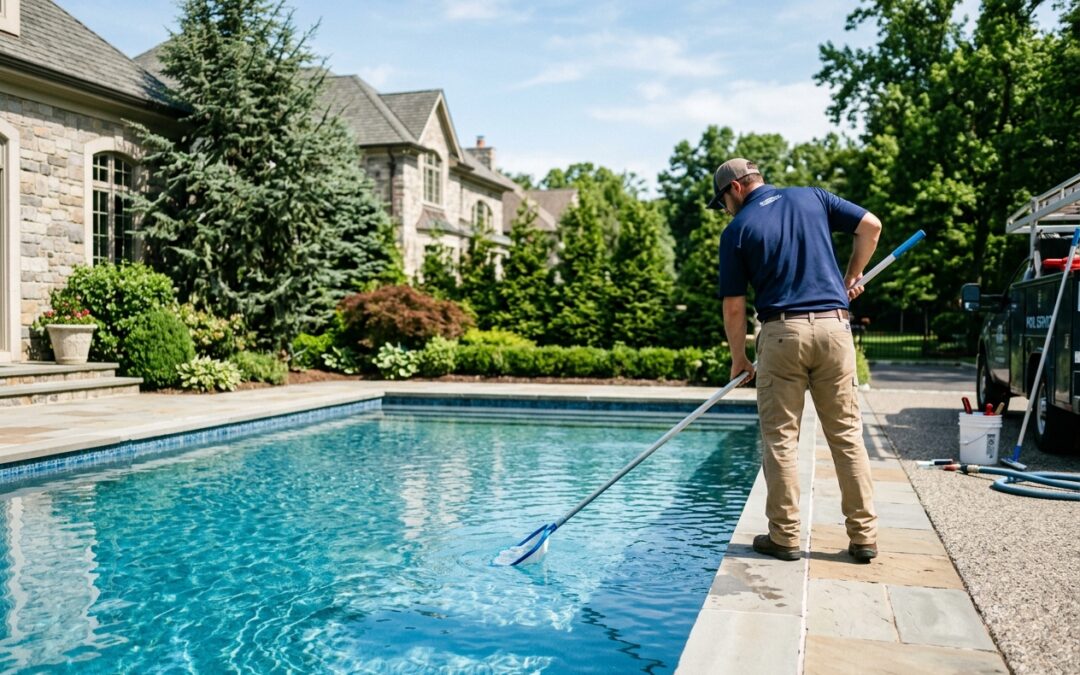
Each weekly visit should include water testing, chemical adjustment, skimming, brushing walls and tile lines, vacuuming, cleaning skimmer and pump baskets, inspecting the filter pressure (a reading 8-10 psi above your clean baseline signals it’s time for a cleaning), and checking all equipment for unusual noise or vibration. Skipping brushing even for a couple of weeks can allow algae to establish in porous surfaces, creating a problem that’s far more expensive to fix than prevent.
Consistency matters here. A pool that receives erratic care, with visits missed due to weather or scheduling conflicts, develops chemical swings that stress the finish and equipment. Wayves includes automated weather rescheduling at no extra charge, so a rainy Tuesday simply means a Wednesday visit instead of a missed week.
Opening and Closing Services for NJ Seasons
Pool openings and closings in New Jersey aren’t single-step events. A proper opening is a two-visit process. The first visit involves removing the cover, reconnecting equipment, cleaning debris, shocking the water, and running the system. A few days later, the second visit confirms that chemistry has stabilized, the water is balanced and safe, the equipment is running correctly, and the deck area is swim-ready. Rushing this into a single visit means you’re swimming in water that hasn’t been verified.
Closings are equally methodical. Lowering the water level, blowing out plumbing lines to prevent freeze damage, adding winterizing chemicals, and securing the cover all need to happen in the right order. In towns like Englewood Cliffs, Alpine, and Demarest, where pools often include complex plumbing for spas and water features, a missed line can mean a cracked pipe and a costly spring repair.
Expert Equipment Repair and Modern Upgrades
Pool equipment doesn’t last forever, and even well-maintained systems eventually need attention. The typical lifespan of a pool pump motor is 8-12 years, a heater lasts 10-15 years, and salt chlorine generators usually need cell replacement every 3-5 years. Knowing when to repair versus replace is where a skilled technician earns their value.
A provider backed by real construction and engineering knowledge can diagnose problems that a general maintenance company might miss entirely. Wayves is backed by SJ Pools, New Jersey’s top pool builder, which means their technicians understand not just surface-level maintenance but the structural and mechanical systems underneath.
Energy-Efficient Pump and Filter Installations
Variable-speed pumps have become the standard for good reason. They use up to 80% less energy than single-speed models and run quieter, which matters on properties in Tenafly and Saddle River where outdoor living spaces are designed for entertaining. Most Bergen County homeowners recoup the cost of a variable-speed upgrade within two to three years through lower electric bills alone.
Filter upgrades deserve similar consideration. Cartridge filters offer finer filtration than sand (10-15 microns versus 20-40 microns) and don’t require backwashing, which wastes hundreds of gallons of water each cycle. If your filter is more than seven years old or you’re noticing persistent cloudiness despite balanced chemistry, it’s likely time for an evaluation. A good technician will check your filter pressure at every visit and flag gradual increases that indicate declining performance before it becomes a visible water quality issue.
Smart Pool Automation and Remote Monitoring
Modern automation systems from manufacturers like Pentair and Jandy let you control pumps, heaters, lights, and water features from your phone. For homeowners who travel frequently or split time between properties, this kind of control is practical, not just convenient. You can confirm your heater is running before a Friday evening arrival or shut down your system during an unexpected power event.
Integrating automation with a professional service provider creates an extra layer of oversight. Your technician can identify when equipment is cycling abnormally or when runtime schedules need seasonal adjustment. During peak summer, pumps should run 10-12 hours daily to maintain proper turnover. In early spring and late fall, 6-8 hours is usually sufficient. Automation makes those transitions simple and keeps energy costs in check.
Professional Pool Renovation and Resurfacing
Even the most carefully maintained pool will eventually need cosmetic or structural work. Plaster surfaces typically last 8-12 years before showing signs of etching, staining, or roughness. Pebble finishes last longer, often 15-20 years, but they’re not immune to calcium deposits and mineral staining that dull their appearance over time.
Renovation work should be planned during the off-season, ideally between November and March, so your pool is ready when the weather warms. A provider who handles both maintenance and renovation can identify early signs of surface degradation during routine visits and help you plan ahead rather than react to a problem mid-season.
Tile and Coping Restoration
Waterline tile takes a beating from fluctuating water levels, calcium scale, and freeze-thaw cycles. Cracked or loose tiles aren’t just cosmetic issues: they allow water to penetrate behind the tile line and damage the bond beam, which is a structural repair that costs significantly more than replacing a few tiles.
Coping stones, the capstones around your pool’s edge, can shift or crack as the ground settles. This is particularly common in Ridgewood and other Bergen County towns with clay-heavy soil. Annual inspection of coping joints during your opening visit catches small gaps before they become tripping hazards or water intrusion points. Regrouting coping every few years is a minor expense that prevents major headaches.
Leak Detection and Structural Repairs
A pool losing more than a quarter inch of water per day (beyond normal evaporation) likely has a leak. The source could be a cracked return line, a failing light niche gasket, or a separation in the shell itself. Professional leak detection uses pressure testing on individual plumbing lines and sometimes electronic listening equipment to pinpoint the exact location without tearing up your deck unnecessarily.
Structural cracks in the pool shell, while rare in well-built pools, require prompt attention. A hairline crack in gunite or shotcrete can widen through freeze-thaw cycles and eventually compromise the pool’s watertight integrity. If your technician notices a new crack during a routine visit, getting it evaluated quickly can mean the difference between a simple epoxy injection and a full-section replaster.
Choosing the Right Local Pool Technician
The difference between an adequate pool technician and an exceptional one shows up over time. An adequate technician keeps your water clear most weeks. An exceptional one catches a failing bearing in your pump motor before it seizes, notices a subtle chemistry trend that suggests a developing problem, and communicates proactively so you’re never surprised.
Look for a company that employs full-time, year-round technicians rather than seasonal hires who cycle through each summer. Year-round employees develop deeper expertise and take ownership of the properties they serve. One Wayves homeowner put it well in a recent review: “They understand complex systems, automation, chemistry, and equipment the way a serious homeowner expects. Everything is precise, professional, and clearly thought through.”
Licensing and Insurance Requirements in New Jersey
New Jersey requires pool service companies to carry general liability insurance and workers’ compensation coverage. Ask for proof of both before allowing anyone on your property. A minimum of $1 million in general liability is standard for residential work, and reputable companies carry more.
NJ also requires compliance with specific health codes for residential pool water quality. Your provider should be testing for free chlorine, pH, alkalinity, calcium hardness, cyanuric acid, and total dissolved solids at every visit, not just eyeballing the water and adding chemicals by feel. Detailed chemical reporting after each visit isn’t a luxury: it’s how you verify the work is actually being done correctly. Ask any prospective provider whether they deliver written chemical reports, and pay attention to the answer.
Enhancing Your Outdoor Oasis in Bergen County
Your pool doesn’t exist in isolation. It’s part of a larger outdoor space that includes decking, landscaping, furniture, and often an outdoor kitchen or entertaining area. The best pool service providers understand this and treat the surrounding area with the same care as the water itself, clearing debris from the deck, straightening furniture, and leaving the space swim-ready after every visit.
Wayves serves hundreds of Bergen County homeowners across 20+ towns, from Alpine and Englewood Cliffs to Demarest and beyond, with all-inclusive pricing that covers courtesy visits, winter treatment, and everything in between. There are no surprise charges, no chemical invoices, and no awkward conversations about what’s included.
If you’ve been settling for inconsistent service or simply want your pool care to match the standard of the rest of your home, it might be worth a conversation. You can schedule a quick call with the Wayves team to see what a different kind of pool service in Englewood Cliffs actually looks like. Your pool deserves the same attention to detail as the rest of your property, and your weekends deserve to be spent enjoying it.